Queer Places:
2 Stratford Pl, London W1C 1AS, UK
 Blanche Potter Cripps (1851 – June 1, 1905) was born in 1851 to the wealthy industrialist Richard Potter and Laurencina Heyworth. She was one of the celebrated nine Potter
sisters (Lawrencina, Mary,
Georgina, Catherine,
Theresa, Margaret,
Beatrice, Rosalind).
Blanche Potter Cripps (1851 – June 1, 1905) was born in 1851 to the wealthy industrialist Richard Potter and Laurencina Heyworth. She was one of the celebrated nine Potter
sisters (Lawrencina, Mary,
Georgina, Catherine,
Theresa, Margaret,
Beatrice, Rosalind).
Growing up in an upper-middle-class Victorian household, Blanche and her sisters were educated at home, encouraged by their father to read broadly, engage with leading
intellectuals, and think beyond standard Victorian conventions. Within the family, Blanche was often characterized as independent and spirited—sometimes described within
sisterly correspondence as the "difficult one" due to her unwillingness to conform meekly to societal expectations.
In 1877, Blanche married William Harrison Cripps (1850–1923), a rising surgeon at St. Bartholomew's Hospital in London who went on to become a leading specialist in
colorectal surgery.
At the time of their engagement, a surgical career was viewed by the upper-class Potter family as somewhat bourgeois or "not quite the thing". However, when Blanche’s
younger sister, Theresa Potter, subsequently married William’s brother, Charles Cripps (later 1st Baron Parmoor), the Potter-Cripps alliance was fully solidified and
embraced.
Blanche Potter Cripps lived for many years with her husband, William Harrison Cripps, at 2 Stratford Place, Marylebone, London. Stratford Place was their central London
residence, positioned just off Oxford Street. They had five children (three sons and two daughters, including Dr. William Lawrence Cripps and Blanche Julia Cripps).
Blanche died on June 1, 1905, at the age of 54. Following her passing, her funeral instructions were carried out according to her specific personal wishes—to be buried with
her head resting on a Bible and her feet on a work of Shakespeare.
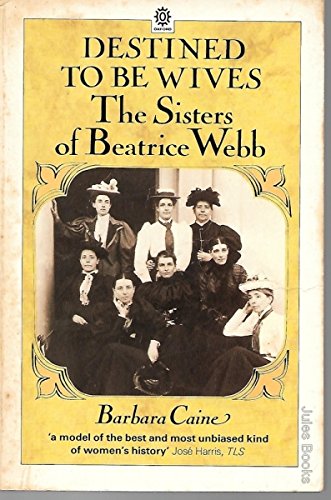
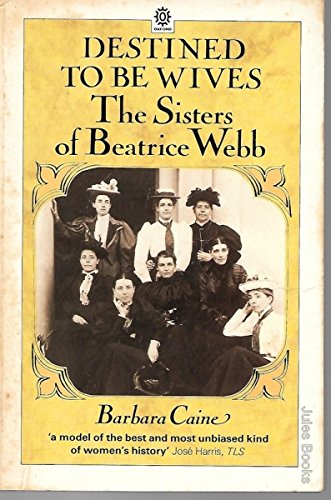
The life of Blanche Potter Cripps—and those of her eight sisters—was famously analyzed by historian Barbara Caine in her biographical study, Destined to be Wives: The
Sisters of Beatrice Webb (1886). Caine’s work uses the Potter family archive to examine how late-Victorian women navigated gender boundaries, domesticity, and female
relationships.
In 19th-century gender and queer history, the intense emotional attachments between women (often termed "romantic friendships" or homosocial bonds) served as primary
sources of emotional sustenance.
The nine Potter sisters constructed an exceptionally tight-knit, lifelong emotional network. Through constant correspondence, shared living spaces, and collaborative
domestic arrangements, they relied far more heavily on each other for intellectual and emotional intimacy than on traditional marital bonds alone.
While Blanche followed the expected path of marriage and motherhood, Caine highlights how these intense same-sex bonds allowed Victorian women to resist total
subordination within patriarchal marriages.
The Potter sisters repeatedly challenged Victorian norms surrounding female autonomy:
They established co-living arrangements during periods of illness, childbirth, or personal distress, temporarily creating female-centered households.
They supported one another’s intellectual pursuits, political ambitions, and social reform work (most famously seen in Beatrice Webb's work, but shared across the
sisterhood).
In 20th-century queer and gender historiography, the Potter sisters are frequently cited as key historical examples of how Victorian women constructed non-traditional,
female-centered support systems that blurred the lines between sororal duty, romantic friendship, and gender rebellion.
References:
Other references:
- Passfield Papers (LSE Library Archives and Special Collections, Ref: GB 97 PASSFIELD)
- Webb, Beatrice. The Diary of Beatrice Webb (Edited by Norman and Jeanne MacKenzie, 4 vols., Virago / London School of Economics, 1982–1985)
- Webb, Beatrice. My Apprenticeship (London: Longmans, Green & Co., 1926)
- Caine, Barbara. "Feminist Biography and Feminist History." Women's History Review, Vol. 3, No. 2 (1994): pp. 247–261.
- Smith-Rosenberg, Carroll. "The Female World of Love and Ritual: Relations Between Women in Nineteenth-Century America." Signs: Journal of Women in Culture and Society, Vol. 1, No. 1 (1975): pp. 1–29.
- Dictionary of National Biography (DNB) & Oxford DNB Entries: Entry for Cripps, William Harrison (1850–1923), surgeon at St. Bartholomew's Hospital (husband of Blanche Potter).
- Dictionary of National Biography (DNB) & Oxford DNB Entries: Entry for Webb, (Martha) Beatrice (1858–1943), sociologist and social reformer.
- Dictionary of National Biography (DNB) & Oxford DNB Entries: Entry for Cripps, Charles Alfred, first Baron Parmoor (1852–1941) (husband of Theresa Potter, Blanche’s sister).
Support this project
This website is a passion project researched, developed, and funded entirely by me. If you find the content valuable and would like to help support the ongoing research and hosting costs, any contribution is deeply appreciated.
Thank you for keeping this independent resource alive!
My books on Amazon: Elisa Rolle's books
BACK TO HOME PAGE